
“Fawning” is a trauma response learned in the context of emotionally unavailable or immature parents in childhood. In this post, I will be using people-pleasing and fawning interchangeably.
Something is given up in the act of people-pleasing. At the most extreme end of the spectrum, you become fused with the people-pleaser mask. You become the fawn, and become the nice person.
It is natural to want to be liked. Most people want to be helpful to others and to be in good standing; to be on peoples’ good sides. But we can also become completely identified with the desire to be liked, and the idea that we know what’s good for other people.
Being completely identified with being a people-pleaser means operating from a place of self-abnegation. It means interacting with others from a place of unmitigated desire, from unmet need, and even from a place of knowing-whats-best for people.
Giving becomes a self-righteous act. It’s not necessarily coming from the idea that a person’s needs are more important than yours, but rather, “this person is what I see in front of me. My goal is to make them happy, and I’ll become happy in the process. I know what’s good for this person, and I’m going to give it to them.” There is a fusion with other people and with the moment. A person’s response to our people-pleasing becomes our entire world.
There’s a projection that happens. We need the person we desire to please to become everything for us. We prop the person all the way up and pedastalize them. We give all of our energy to them with little conscious consideration of ourselves in the process, and they become the entire frame and context of the moment. We put a bizarro kind of deified godhead on people, and completely lose track of ourselves. We idealize others.
Fire Hydrants
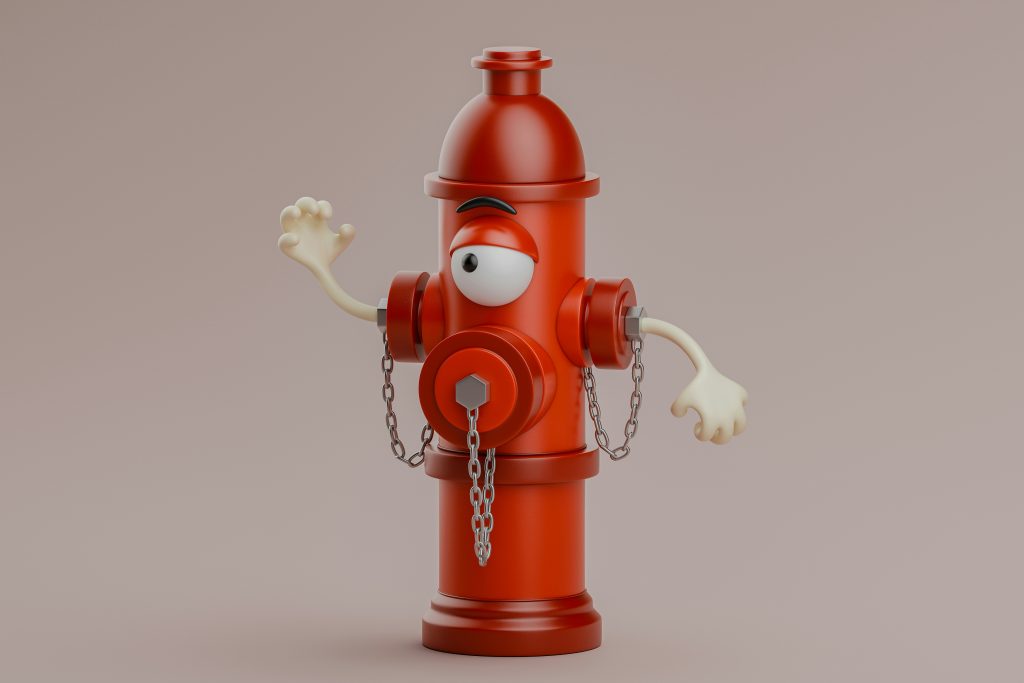
Fawning is a kind of uncontained energy given out freely. It doesn’t have a container.
A fire hydrant has a singular purpose by design. It’s meant to put fires out. It’s meant to be used when it’s necessary.
In childhood, people-pleasers were given specific roles and purposes. Be useful and helpful, but only when needed, and especially in a crisis.
When a fire hydrant is cracked open, it’s uncontained, but free for everyone to use. All of that resource ultimately becomes wasted, spilling out.
Like a fire hydrant, the fawn is considered a useful object to emotionally immature caregivers, and a free resource to those who emotionally neglect their children. In childhood, people-pleasing is a means for survival. In adulthood, people-pleasing means allowing your energy to be used freely, all of the time, for anyone and everyone.
People-pleasers likely grew up as the black sheep of the family: the child most ignored or neglected emotionally, but also the most aware of what was going on. The ones who were hyper-aware of the dynamics, who were aware where they were needed, who knew how to shape-shift in order to receive a modicum amount of attention. They became their family’s constant resource, always available to put out a crisis or soften the mood.
Later in life and out there in the “real” world, the people-pleasing gets broken open. Freely distributed outside the confines of home. Fawns often get taken for granted, their kindness treated as something freely and readily available for the taking.
Securely-Attached Responses to Fawning
A securely attached person will likely pick up on people-pleasing behavior and feel something is up. “This person’s so nice, they’re so giving.” On a nervous-system level, they’ll become repelled by their own thought of it. They don’t know what to do with the energy of the moment. They don’t know how to be the container for the pleasing, because on some level, they understand what’s at stake. They understand what a fawning person is giving in the totality of it, and they feel it. People who are securely attached understand their limitations in regards to others, and they know where can meet people at mentally, physically, and emotionally. If someone fawning projects so much of energy and desire onto them, a securely-attached person will feel their limits. They understand their own limitations on a human level, and feel repelled by the overtly-kind acts. They respond naturally and accordingly, in service of their own needs.
On the other hand, a people-pleaser will also invite people into their lives who are hungry for attention, who are overtly identified with their own grandiosity and need for admiration. This person will accept the fawn’s projection and the idealization, and likely be aware of what’s happening in the interaction without saying it. They understand the fawn’s desire to be of service, and there is probably a very good feeling in it for them. It’s not reciprocal. They feel empowered. They feel a high. It puts them in a seat of power. The interaction quenches their own thirst and need for love, admiration, attention, and service. The fawn, somehow, is oblivious to all of this, just praying the interaction goes well, and praying they perform well in the process.
On this end, people-pleasers invite actual danger in the form of users, abusers, takers, and people who generally generate their self-esteem from what they can take from others. There is a resonance here that happens between extreme givers and extreme users.
In the people-pleasing mode, your signals for relational danger are turned off.
Healing
Healing the people-pleaser starts with recognizing the people-pleasing for what it is, all the way down to its core: there is inherent goodness in it. The desire in it, the spirit of it.
People-pleasing is being of service, but it’s just been in service to everything else outside.
It means taking that desire and that goodness, and being of service to yourself, in the same way you’ve been to others.
Maybe the idea draws a blank. While it might not seem worthwhile, reaching beneath the identity of the people-pleaser means understanding that it comes from something real, good, and loving.
The Mirror
The people-pleaser in us needs us to fawn back in response.
That silent, listening relationship can become a mirror.
We often feel unfulfilled, impatient, lost, angry, resentful, disappointed, or frustrated, and we place those feelings onto other people and other things. “Well, if I just had this opportunity, if this person had responded the way I imagined they would to my kindness… my whole life would be infinitely better. My day wouldn’t have been ruined.”
We put so much hope and desire into singular moments, and lose sight of the bigger picture of our lives and our worth. We listen to our nervous system and how it responds to these negative moments, feelings of loss, betrayal, rejection, frustration, what have you. We take these responses as truth to our entire being.
We allow other people to dampen us because they couldn’t meet us where we wanted to be met, in our hunger to have our needs seen and met in completeness.
What if we recognized what these moments mean to us? What if we recognized our need, and how big that need feels?
In this way, we see our need and meet it.
The Compass
When we recognize our need, the fawn starts to have a focus, a direction, and a container. An arrow and a compass. It’s not just being flung out everywhere. It has a directionality and a purpose, rather than being fire-at-will for anyone and everyone.
We start to choose. We start to discern, for the sake of that inherent goodness in ourselves. Not everybody deserves the fawn. We deserve more of it for ourselves.
The fawn believes everybody needs love, everybody is deserving. You point that same belief into yourself, and you see that there’s a deeper part of you that wants to listen to you, and that wants to be of service to you. The spirit that goes out, is instead seen and reflected on for what it truly is in all of its compassion.
When the energy is mirrored back inward and the reflection is truly seen, the healthy container starts to develop.
Sitting with a Shadow

You’re being nice, you’re fawning.
When you really sit down with yourself and acknowledge that part of yourself, you may not like what you find. What you might feel is something like a rock, or a stone at the heart of it. Disturbing. Alien. Numb. Frozen. Empty.
You arrive at an identity-level doubt about how much you give people, and understand what you receive in return. There likely becomes some confusion around it.
“If I’m not a people-pleaser, then what am I?”
“I feel confused about how to respond to people. I feel guilty. I feel dread. This is wrong.”
“How much do I receive back? What do I need?”
It might feel right to leap back into the fawning response immediately. “I’m uncomfortable, so I’ll just throw myself at the situation. That’s the simple solution.” There’s that comfortable, well-worn drive to be as nice and as helpful and as giving as possible. But, if you pause right before that leap, you might notice that there is some discomfort there.
But there’s an even bigger layer underneath.
“What do I actually want? What do I need?”
If you’re not going to throw yourself at the situation, what is the alternative? What does it even mean to have an alternative? Underneath that nervous-system response to fawn is often an underlying sense of dread.
The Escape

We fly away from ourselves and into our interactions with others. There’s a lightness to it, and we fight ourselves in that process automatically, sometimes unconsciously denying those other layers of feeling within ourselves.
But what do confusion and self-doubt require? What is the alternative? What is a compassionate response to my own feelings here?
If someone you cared about was confused about how to respond to something, how would you respond to them? Not for the other person. Just for you.
Relational Trauma
People-pleasing can have its roots in trauma, and in being of service to families entrenched in shame. If you grew up in a family where everything was about being useful, managing emotions, being a good listener, being kind, fitting the box other people put you in, these roles often become people-pleasing in adulthood. Essentially, you were forced to be emotionally mute.
You learned to please in order to be pleased. You had to derive pleasure from feeling good because the opposite meant feeling utterly destroyed. What would have happened in your family if you didn’t fit the role they gave you? You would have been shunned. Raged at. Neglected. Ignored. Rendered useless.
Challenging the people-pleaser identity means putting an entire system of family shame and belonging at jeopardy. Being of service to the emotionally unavailable is not the same as receiving connection, warmth, or belonging, and yet it registers as connection, because of years and years of being shown nothing else. This creates profound issues with self-esteem, connection, and personal fulfillment later in life.
In healing, we are asking to challenge what are likely generations of relational trauma, down the family line. This is not a small ask in healing the fawn.
We have to grieve. We have to understand what was taken from us. We anger at it. We anger at the times and the people who didn’t afford us the opportunity to express ourselves differently. We see how far this picture extends, we feel the horror in that, and we feel the scope of our lives emerge.
The People-Pleaser Mask
People-pleasing is larger than life. It’s the larger-than-life personalities. It’s the performance of it all.
Zoom out of your own people-pleasing and you see the full scope of it.
People-pleasing is a shared mask. The charisma of it, the caricature of it. We fine-tune our masks to be as palatable as possible, to hit people’s nervous systems in a way that elicits the most joyous, high-energy responses. We find ourselves in communal circles where people-pleasing is the relational norm, and where authenticity is shunned or creates relational risk. We find ourselves in groups of people collectively, genuinely afraid of authenticity. We find ourselves in feedback loops with other people-pleasers. We have to be pleasing and palatable to operate within these social contexts.
“This is wrong. I feel wrong. I feel depressed. Nothing feels right.” We hear these signals as a referendum and as a diagnosis, a grade on our life that we are not right, not good. We feel exhausted and depressed at the end of the day. People-pleasers understand that by managing other people’s emotions, we can keep our own feelings at bay. Terrified to feel, terrified of our own mortality, because it reminds us of a time where being authentic meant being absolutely destroyed by the people closest to us. And so, authenticity became a danger to safety.
Later in life, we feel alien to ourselves in our most isolated moments. Life becomes about prosocial relationships, work, responsibilities, duties, service, everything outside of you. It becomes a painful confirmation of everything that came before.
We remember why we people-pleased in the first place and realize we were surrounded. Our parents. Their parents. The people closest to us were themselves people-pleasers, putting on their best masks, hiding their deep traumas. We see how far it stretches back, and we realize the burden isn’t solely ours.
For creative people who grew up in performance-oriented families, so much of communication and connection became about being the ultimate expression of charisma and palatability. You grew up watching family put on such a show that when they came home, completely spent, you had to interact with their own, unlived selves. You saw it manifest as rage, as avoidance, or a hidden depression that was always acted out, but never spoken.
As a kid, you became subject to the unlived lives of your family. You started managing their unlived lives, their immature emotions. The irony is that in the people-pleasing, we’re managing everybody’s pain, and other people are managing ours in return, and everybody is just trying to keep everything up. Like a drug, keeping the dopamine up, keeping the party and the good vibes alive.
The bad feelings are unpalatable. Depression is unacceptable. Depression is mysterious. There’s no language around it, no acceptance of it, no container for it. Charm, charisma, lights, cameras, the language of success and brilliance and hope and aesthetics and pleasure. We forget. We leave ourselves behind. We people-please to oblivion, and we lose sight of ourselves in the process. We do the work and get to the bottom and feel disturbed, and we don’t understand why, because no one ever saw or wanted to see us in our shame and our humanity, in that most rich and deserving part of ourselves. The part that needed to love, and that needed to be seen.
The Reality
We live in a society that demands people-pleasing on some level. We find ourselves at the doorsteps of those who are hungry for attention and admiration, who are confused about love and relating just as much as we are. We find ourselves giving, overcompensating, laughing a little too hard, showering a few too many compliments, being a little too charming, and we recognize ourselves doing it, and we feel the self-loathing in it. We don’t know what to do with it.
The world revolves around people-pleasing to varying degrees. But we do have a choice, and we do have agency in how we respond to people. The illusion, and the trauma, is the idea that we don’t.
Having agency probably doesn’t mean a complete reversal of situations we abhor. It doesn’t mean rejecting the world entirely.
Instead, we adopt the people-pleaser. We find the utility in it rather than being fused with it. We notice ourselves using the mask, and we understand why: how we respond to people, and why people demand people-pleasing from us. We take notes.
We see what people need and desire, and we are able to play the role and play the song, if we choose. We understand why we do it, not as an act of complacency, but from a place of strength and courage. Not from survival, but from self-cultivation. From learning, and from compassion, and from understanding that the people-pleasing is relegated to the moment.
For someone who has experienced deep familial or relational trauma, a moment of people-pleasing can feel like an eternity. It can feel timeless. It can transport us back to childhood and those feeling states. It fills us with terror.
But we meet all of that with compassion and empathy, and we operate on wisdom. We understand the time-limitedness of our interactions with others, and we find courage and levity in that. We see the reality of the moment and the greater scope of our lives. We see the people-pleaser as a utility, as a mask to be worn, not in service to others, but in service of ourselves.
EMDR
Thank you for reading this post.
If you experienced childhood trauma, or grew up entrenched in a family role, EMDR therapy can help unpack those narratives and begin a healing process. Through EMDR, we create new experiences in an affirming context, one that affirms who you are. If you’d like to explore this work together, I’d love to connect.